
Mastering String and Array Methods in JavaScript (By Building Them Yourself)
Stop Using Methods Blindly — Learn to Build Them and Think Like JavaScript
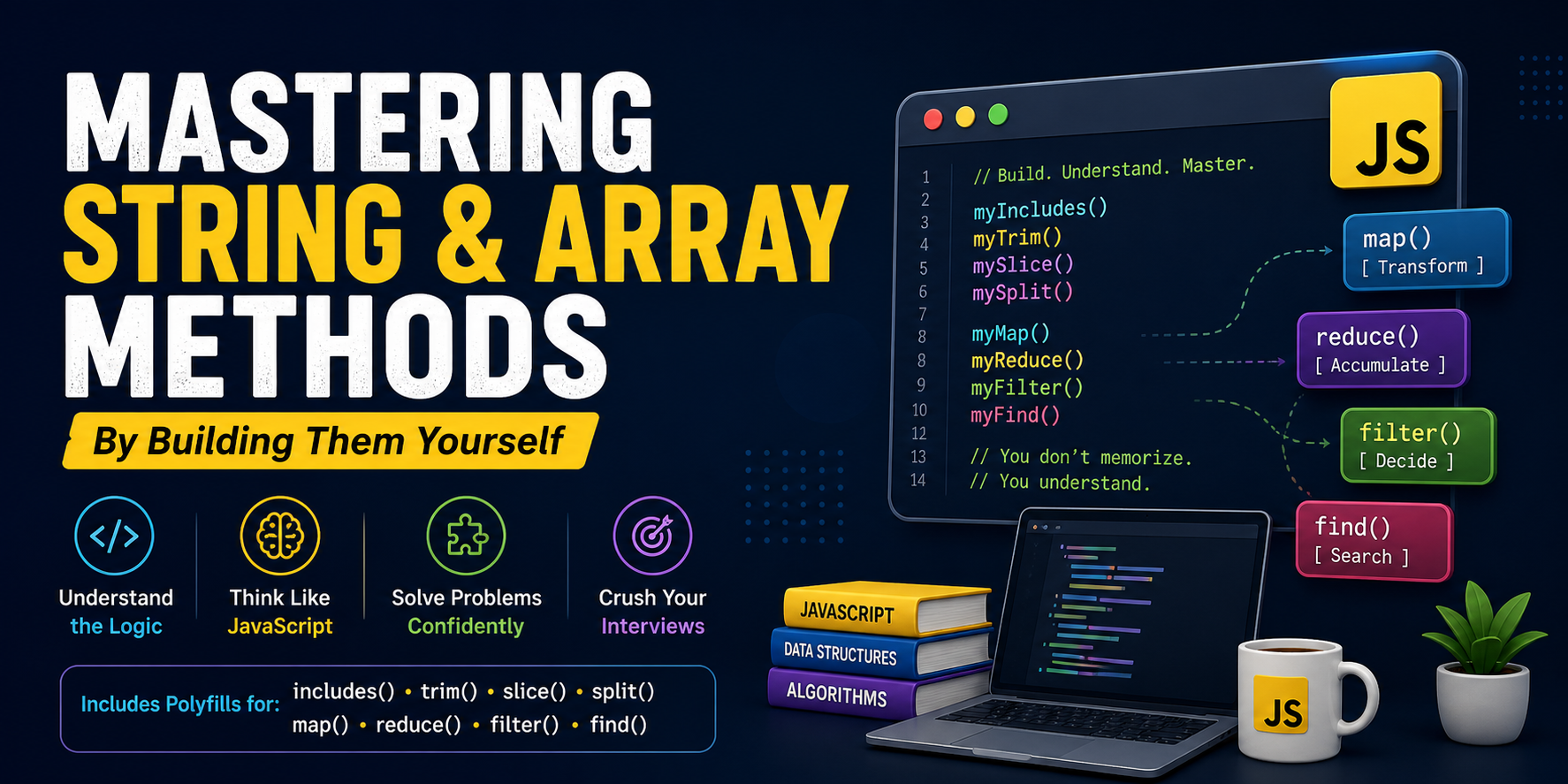
Most developers use methods like .trim(), .slice(), .map(), or .reduce() every day.
They work smoothly, feel intuitive, and save time.
But here’s the uncomfortable truth:
if you can’t implement these methods yourself, you don’t really understand them.
And in interviews, that difference becomes obvious very quickly.
This blog is not about memorizing methods.
It’s about understanding the logic behind them — the kind of understanding that actually builds confidence and problem-solving ability.
What Are String and Array Methods?
In JavaScript, strings and arrays come with built-in methods that help you manipulate data.
"hello".toUpperCase(); // "HELLO"
[1, 2, 3].map(x => x * 2); // [2, 4, 6]
These methods are not magic.
They are simply functions implemented internally by JavaScript.
Which means one important thing:
you can build them yourself.
And once you do that, you stop guessing and start understanding.
Why Developers Write Polyfills
A polyfill is your own implementation of a built-in method.
At first glance, this might feel unnecessary. After all, JavaScript already gives you these methods.
But writing them yourself forces you to think like the engine.
You begin to see how iteration works, how conditions are applied, how results are built step by step.
This is exactly what interviews test. Not whether you know a method exists, but whether you can recreate its behavior when needed.
Understanding the Logic Behind Methods
Every method, no matter how complex it looks, follows a simple pattern.
You iterate over data.
You apply some logic.
You build a result.
You return it.
Once this pattern becomes clear, a lot of “difficult” problems stop being difficult.
Building String Methods from Scratch
Let’s start with string methods. These are often used in parsing, validation, and text processing.
Custom includes()
function myIncludes(str, search) {
  for (let i = 0; i <= str.length - search.length; i++) {
    let match = true;

    for (let j = 0; j < search.length; j++) {
      if (str[i + j] !== search[j]) {
        match = false;
        break;
      }
    }

    if (match) return true;
  }

  return false;
}
This works by checking each possible position in the string and comparing characters one by one. The moment a full match is found, it returns true.
Custom trim()
function myTrim(str) {
  let start = 0;
  let end = str.length - 1;

  while (start <= end && str[start] === " ") start++;
  while (end >= start && str[end] === " ") end--;

  let result = "";
  for (let i = start; i <= end; i++) {
    result += str[i];
  }

  return result;
}
This approach uses two pointers to remove spaces from both ends without touching the middle of the string.
Custom slice()
function mySlice(str, start, end) {
  let result = "";

  if (start < 0) start = str.length + start;
  if (end === undefined) end = str.length;
  if (end < 0) end = str.length + end;

  for (let i = start; i < end && i < str.length; i++) {
    if (i >= 0) result += str[i];
  }

  return result;
}
Here, the main challenge is handling negative indices and boundaries correctly.
Custom split()
function mySplit(str, delimiter) {
  let result = [];
  let current = "";

  for (let i = 0; i < str.length; i++) {
    if (str[i] === delimiter) {
      result.push(current);
      current = "";
    } else {
      current += str[i];
    }
  }

  result.push(current);
  return result;
}
This method builds pieces of a string and pushes them into an array whenever it encounters a delimiter.
Building Array Methods from Scratch
Now we move to array methods. This is where interview questions become more interesting because these methods involve callbacks and dynamic behavior.
Custom map()
function myMap(arr, callback) {
  let result = [];

  for (let i = 0; i < arr.length; i++) {
    result.push(callback(arr[i], i, arr));
  }

  return result;
}
This method transforms each element and builds a new array based on the callback logic.
Custom reduce()
function myReduce(arr, callback, initialValue) {
  let accumulator = initialValue;
  let startIndex = 0;

  if (accumulator === undefined) {
    accumulator = arr[0];
    startIndex = 1;
  }

  for (let i = startIndex; i < arr.length; i++) {
    accumulator = callback(accumulator, arr[i], i, arr);
  }

  return accumulator;
}
This is one of the most important methods to understand because it teaches accumulation and state management across iterations.
Custom filter()
function myFilter(arr, callback) {
  let result = [];

  for (let i = 0; i < arr.length; i++) {
    if (callback(arr[i], i, arr)) {
      result.push(arr[i]);
    }
  }

  return result;
}
This method keeps only those elements that satisfy a condition.
Custom find()
function myFind(arr, callback) {
  for (let i = 0; i < arr.length; i++) {
    if (callback(arr[i], i, arr)) {
      return arr[i];
    }
  }

  return undefined;
}
This method stops as soon as it finds the first matching element, which makes it efficient for search operations.
Why This Understanding Changes Everything
At this point, something important should click.
All these methods are not separate concepts.
They are variations of the same idea — iteration + logic + result.
Once you internalize this, you stop depending on methods and start building solutions.
That’s exactly what interviews are looking for.
Final Thoughts
JavaScript methods are not shortcuts.
They are patterns.
When you understand those patterns, you gain control over your code.
You stop guessing.
You stop memorizing.
You start thinking.
And that shift is what separates someone who is learning JavaScript from someone who actually understands it.


