

What is Node.js? JavaScript on the Server Explained
How JavaScript Started Running Beyond the Browser
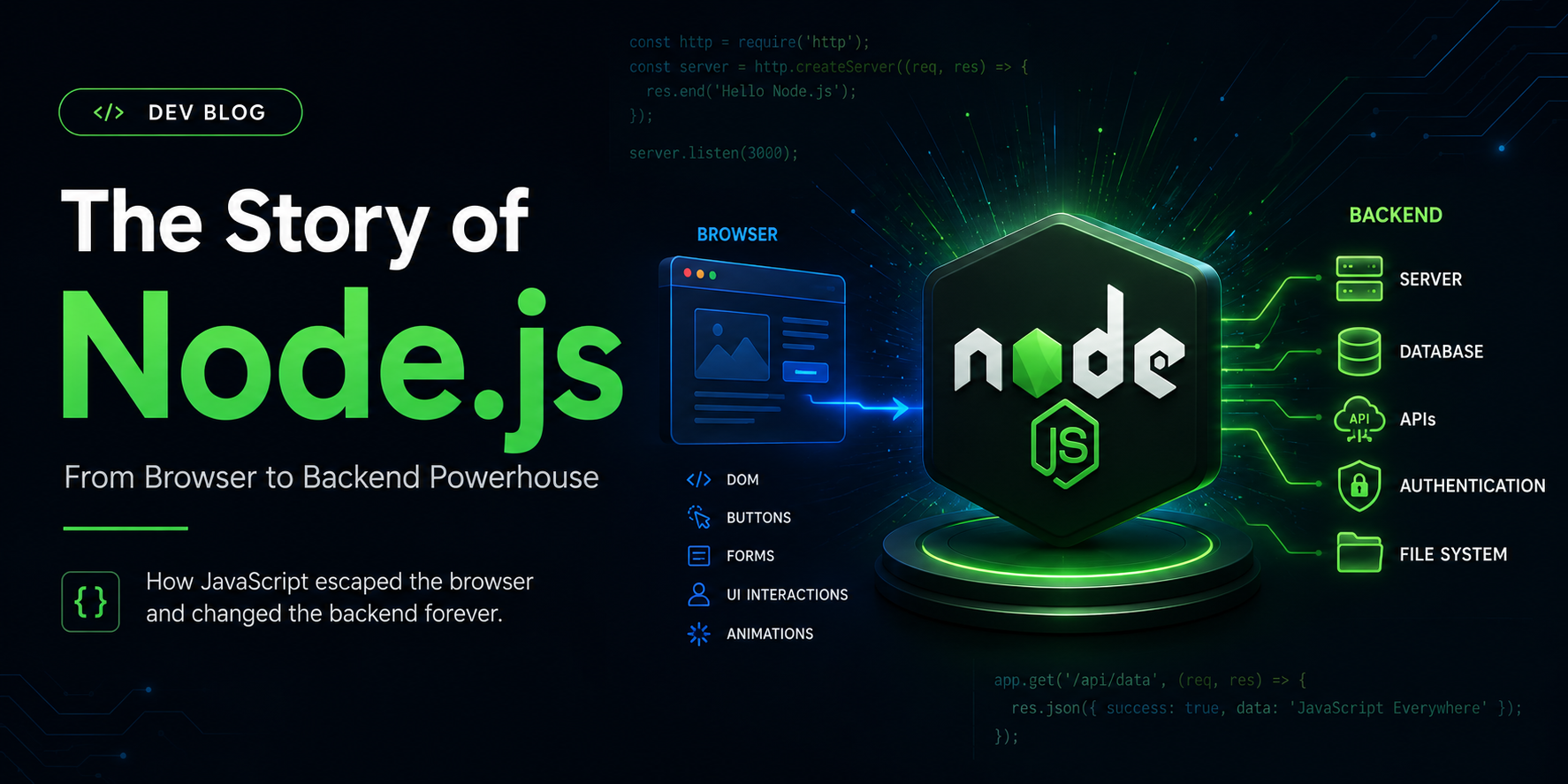
When most people start learning JavaScript, they usually think of it as the language that makes websites interactive. Buttons click, forms validate, dropdowns open, and pages update without refreshing. That’s the version of JavaScript most beginners first experience.
It lived inside browsers.
Its responsibilities were simple:
make buttons interactive, validate forms, create dropdown menus, and update parts of a webpage without refreshing
That was it.
If developers wanted to build the backend of an application — the part responsible for databases, authentication, APIs, file handling, or server logic — they usually turned to languages like PHP, Java, Python, or Ruby.
JavaScript wasn’t even part of the conversation.
But at some point, developers started asking an interesting question:
What if JavaScript could run outside the browser too?
That question eventually led to Node.js, and it completely changed modern web development.
Today, developers can build both the frontend and backend of an application using JavaScript alone. That idea sounds normal now, but before Node.js, it was a huge deal. Companies run massive production systems on Node.js, and countless modern tools exist because of the ecosystem built around it.
To understand why Node.js became so popular, we first need to understand what JavaScript originally was designed for.
Before Node.js, JavaScript Was Browser-Only
JavaScript was originally designed to run inside web browsers.
Browsers like Chrome, Firefox, and Safari contain JavaScript engines capable of understanding and executing JavaScript code.
That’s why code like this works:
document.querySelector("button").addEventListener("click", () => {
  console.log("Button clicked");
});
The browser provides features such as:
the DOM
the
windowobjectevent listeners
page rendering APIs
Without the browser, these things simply don’t exist.
That meant JavaScript wasn’t treated as a serious backend language for many years.
Meanwhile, PHP powered dynamic websites, Java dominated enterprise systems, Python handled servers and automation, and Ruby on Rails became popular for startups.
For a long time, JavaScript could only run inside browsers. It was already extremely popular, but it was still limited to frontend work.
Then Node.js changed everything.
So What Exactly is Node.js?
Node.js is a runtime environment that allows JavaScript to run outside the browser, mainly on servers.
That definition sounds technical, but the idea itself is surprisingly simple.
JavaScript is the programming language.
Node.js is the environment capable of running that language on a server.
This distinction matters because many beginners accidentally think Node.js and JavaScript are the same thing.
They aren’t.
A simple way to think about it is this:
JavaScript is the language itself.
Node.js is just an environment that can run that language outside the browser.
Inside a browser, JavaScript interacts with webpages.
Inside Node.js, JavaScript can create servers, access files, connect databases, handle APIs, process authentication, and manage backend logic.
That was the big breakthrough. Developers no longer needed separate languages for frontend and backend development. JavaScript could now be used across the entire application.
Browser JavaScript vs Node.js
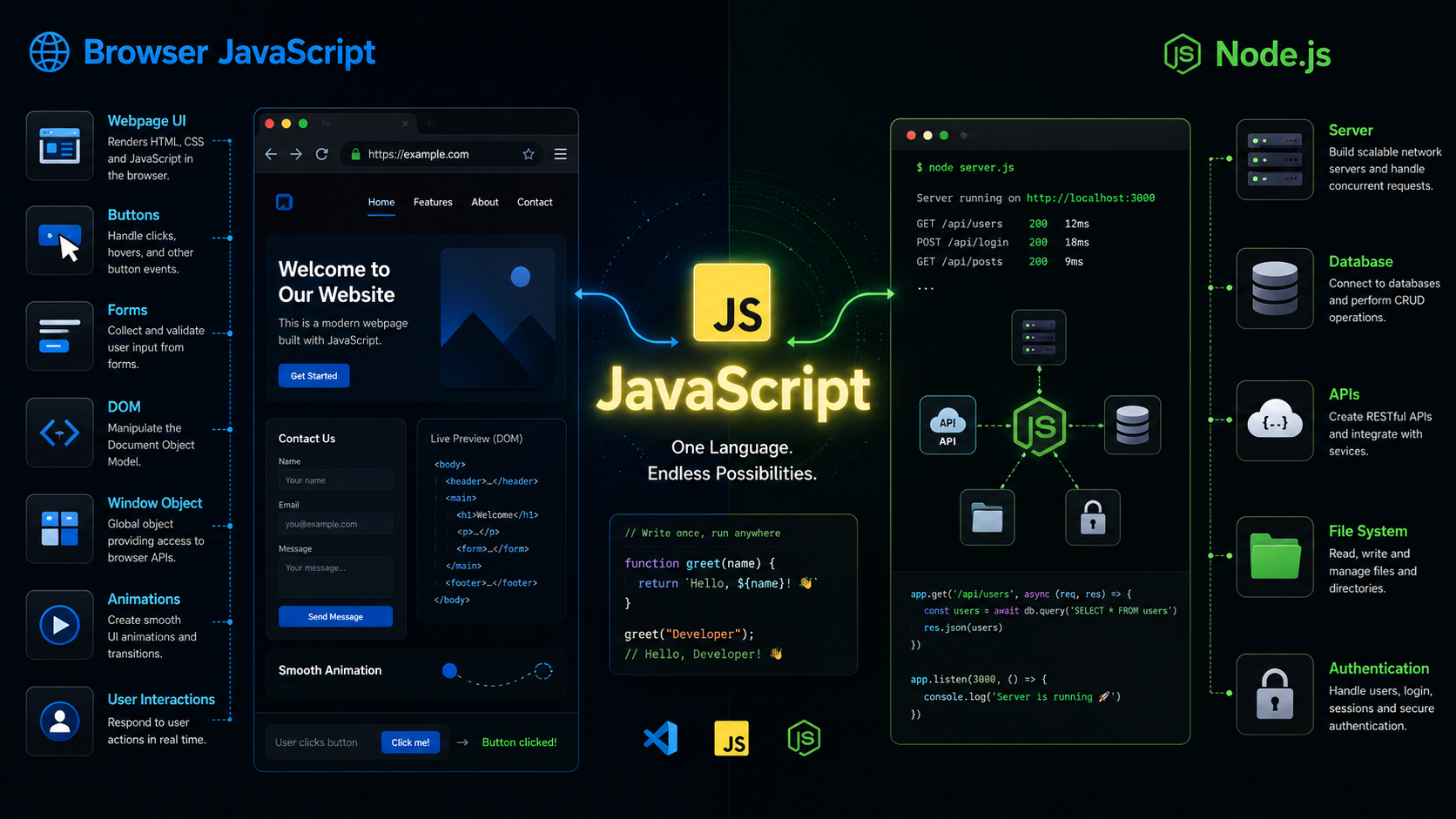
A good way to understand the difference between browser JavaScript and Node.js is to think of a restaurant.
Frontend JavaScript is like the waiter interacting with customers directly. It handles things users can see and interact with, like forms, buttons, animations, and page updates.
Node.js is more like the kitchen working behind the scenes. It handles tasks like talking to databases, processing requests, handling authentication, and preparing data.
The browser focuses on what users see.
Node.js focuses on what happens behind the scenes.
And the interesting part is that both use the same language: JavaScript.
How Node.js Made JavaScript Run on Servers
At the heart of Node.js is something extremely important:
📧entity🌟["software", "V8", "Google Chrome JavaScript engine"]🔁
V8 is the JavaScript engine created for Google Chrome.
Its job is to take JavaScript code and convert it into machine instructions the computer can execute efficiently.
Before Node.js existed, V8 primarily powered JavaScript inside browsers.
Node.js essentially took that engine and used it outside the browser environment.
That decision changed everything.
Because once JavaScript could run independently from browsers, it became capable of handling backend development.
That meant developers could finally use JavaScript to:
const http = require("http");

const server = http.createServer((req, res) => {
  res.end("Hello from Node.js");
});

server.listen(3000);
That small piece of code creates a real backend server. Not a browser feature. Not a webpage interaction. An actual server running outside the browser.
For developers at the time, this was a huge shift.
JavaScript Runtime vs Programming Language
This is where many beginners get confused.
JavaScript itself is just the language.
The runtime environment determines what capabilities the language has access to.
For example, browsers provide browser APIs:
window
localStorage
document
alert()
These only exist because browsers provide them.
Node.js provides completely different APIs:
fs
http
path
process
For example:
const fs = require("fs");

const data = fs.readFileSync("notes.txt", "utf-8");

console.log(data);
This code reads files directly from the computer.
Browsers normally cannot do this for security reasons.
So even though both environments run JavaScript, the capabilities are very different.
That’s why saying “Node.js is JavaScript” is technically incorrect.
Node.js is a runtime environment for JavaScript.
The Big Reason Node.js Became Popular
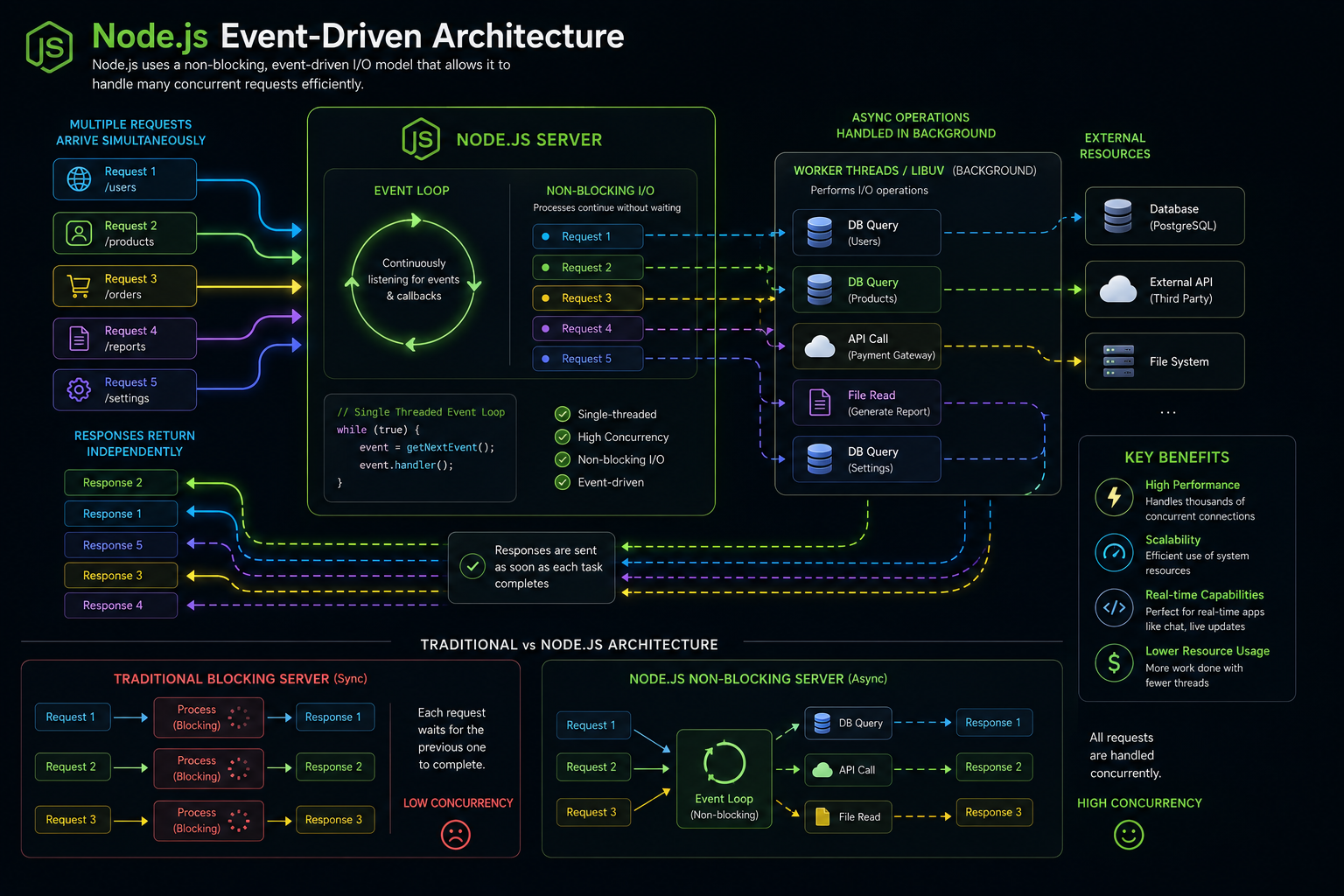
Node.js did not become successful simply because it allowed JavaScript to run on servers. Its real strength came from the way it handled work internally. Traditional backend systems often relied heavily on multiple threads and blocking operations. Node.js approached the problem differently through an event-driven architecture.
At first, that phrase sounds intimidating, but the concept itself is surprisingly practical. Imagine a restaurant where a waiter takes a customer’s order and then stands still doing absolutely nothing until the kitchen finishes cooking the food. That system would become painfully slow very quickly. Now imagine a smarter approach where the waiter takes an order, sends it to the kitchen, and immediately starts serving other customers while the food is being prepared. Once the food is ready, the kitchen signals the waiter.
That is very similar to how Node.js operates. Instead of freezing while waiting for database queries, file reads, API requests, or network operations to finish, Node.js keeps handling other incoming tasks and responds when the operation completes. This approach made Node.js incredibly effective for modern applications that require handling large numbers of simultaneous connections, especially chat systems, streaming platforms, real-time dashboards, multiplayer applications, and APIs.
Why Developers Adopted Node.js So Quickly
Node.js also arrived at the perfect time. Websites were becoming more dynamic, interactive, and app-like. Applications were becoming increasingly dynamic, interactive, and real-time focused. Developers wanted faster workflows, simpler stacks, and better ways to build modern web applications. Node.js managed to provide all three.
One of the biggest reasons for its rapid adoption was the ability to use JavaScript everywhere. Frontend developers could now move into backend development without learning an entirely different language. Companies loved this because teams became more flexible, while startups loved it because products could be developed much faster.
Another major reason developers adopted Node.js so quickly was the growing JavaScript ecosystem. The introduction of ## entity["software","npm","JavaScript package manager"] gave developers access to an enormous collection of reusable packages. Authentication systems, routing libraries, real-time communication tools, validation utilities, and countless other features could now be installed within seconds instead of being built entirely from scratch.
Over time, Node.js became much more than just a backend runtime. It evolved into the foundation of modern JavaScript tooling. Many frontend tools developers use every day — including bundlers, development servers, package managers, and framework tooling — are powered by Node.js behind the scenes. Modern frontend development is deeply connected to the Node.js ecosystem whether developers realize it or not.
Node.js vs Traditional Backend Technologies
Node.js also felt very different from many older backend technologies.
Take PHP, for example.
PHP traditionally followed a request-response lifecycle where execution starts, processes a request, sends a response, and ends.
That worked extremely well for traditional websites and still powers a massive portion of the internet today.
But Node.js felt more dynamic for modern applications requiring continuous communication.
Especially real-time systems.
Java presented a different contrast.
Java is incredibly powerful and widely used in enterprise environments.
But traditionally, Java development involved more configuration, heavier frameworks, and larger setups.
In comparison, Node.js felt lightweight and fast. Developers could quickly build APIs, prototype ideas, and create modern applications without massive amounts of setup. That speed became one of the biggest reasons startups and modern web developers started using Node.js heavily.
Especially for startups.
Especially for modern web applications.
Especially during the rise of single-page applications and frontend-heavy architectures.
But Node.js Isn’t Perfect
No technology is perfect.
And Node.js definitely has trade-offs.
Node.js performs exceptionally well for I/O-heavy operations like APIs, networking, database communication, real-time systems, and asynchronous tasks.
But CPU-intensive operations can become problematic.
Heavy computations may block the event loop and reduce performance.
That’s why large systems often combine multiple technologies instead of relying entirely on Node.js for every workload.
Good engineering is never about blindly following hype.
It’s about choosing the right tool for the right problem.
Node.js happens to be an extremely good tool for many modern web applications.
Real-World Use Cases of Node.js
Today, Node.js powers REST APIs, real-time chat applications, streaming platforms, multiplayer game servers, dashboards, authentication systems, automation tools, command-line utilities, developer tooling, and microservices.
Even many tools web developers use daily rely on Node.js internally.
That includes modern frontend ecosystems built around frameworks and bundlers.
In many ways, Node.js quietly became part of the foundation of modern web development.
The Bigger Impact of Node.js
Node.js didn’t just create another backend technology. It completely changed how developers looked at JavaScript.
Before Node.js, JavaScript was mostly seen as a browser language used for small frontend interactions. After Node.js, developers started building full applications with it. Frontend, backend, APIs, tooling, automation, and even development servers slowly became part of the same JavaScript ecosystem.
Today, when beginners start learning web development, using JavaScript for both frontend and backend feels completely normal. But that only became possible because Node.js proved that JavaScript could do much more than people originally expected.
And honestly, that’s what makes Node.js so important.
It didn’t try to replace JavaScript.
It expanded what JavaScript was capable of.
For many developers, Node.js was the moment JavaScript stopped being “just a browser language” and became a serious tool for building complete applications.
And once that happened, modern web development changed permanently.


